
Sri Aurobindo National History Essay Competition 2025-26
The YUVA programme of FIHCR successfully concluded the Sri Aurobindo National History Essay Competition for the 2025–26 edition.
Supported by the Ministry of Education, Government of India, the competition invited students from across the country to explore India’s rich historical legacy through thought-provoking themes, inspiring deeper engagement with our civilisational heritage and historical traditions.
The 2025–26 edition received an enthusiastic response from young participants across India. Following a rigorous evaluation process, the winners have been announced. FIHCR extends its heartfelt congratulations to all the winners and commends every participant for their curiosity, commitment, and passion for history.
We are grateful to the students, teachers, parents, and schools whose encouragement and support made this edition a success. We look forward to welcoming an even larger community of young historians in the next edition of the Sri Aurobindo National History Essay Competition.
About Sri Aurobindo Ghosh
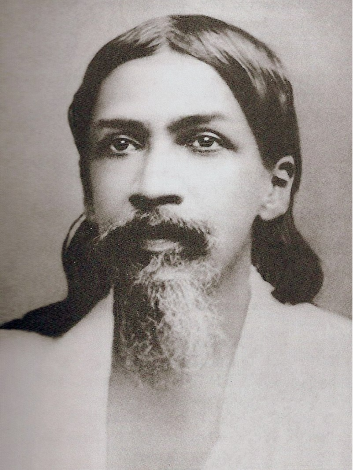
Sri Aurobindo Ghosh (1872–1950) is known for his work as a spiritual visionary but he also played a prominent role in India’s fight for independence. After completing his education in England, he returned to India in 1893 and became a leader in the nationalist movement, advocating for Poorna Swaraj through the newspaper Bande Mataram. In 1910, he shifted his focus to spiritual work and moved to Pondicherry, where he developed “Integral Yoga,” a practice aimed at transforming human consciousness.
He was nominated for the Nobel Prize in two categories, Literature and Peace. FIHCR honours the legacy of Sri Aurobindo by launching the History Essay Competition in his name, hoping that his life and work, which spanned both India’s struggle for independence and the spiritual upliftment of humanity, will inspire many children to explore and appreciate India’s rich heritage.
Meet the Jury



Congratulations once again to all the winners, participants, teachers, schools, jury members, and parents who made this initiative a success. A heartfelt thank you to each one of you for your enthusiasm, encouragement, and support. A special thanks to our partner schools for supporting this initiative and helping us promote the importance of history education. Together, we are inspiring the next generation to discover, understand, and celebrate India’s history.
Eligibility
The competition is open to secondary school students in Grades 7, 8, and 9 from schools across India. A valid school ID or Aadhar Card will be required for participation.
Topics
The topics for each group are as follows:
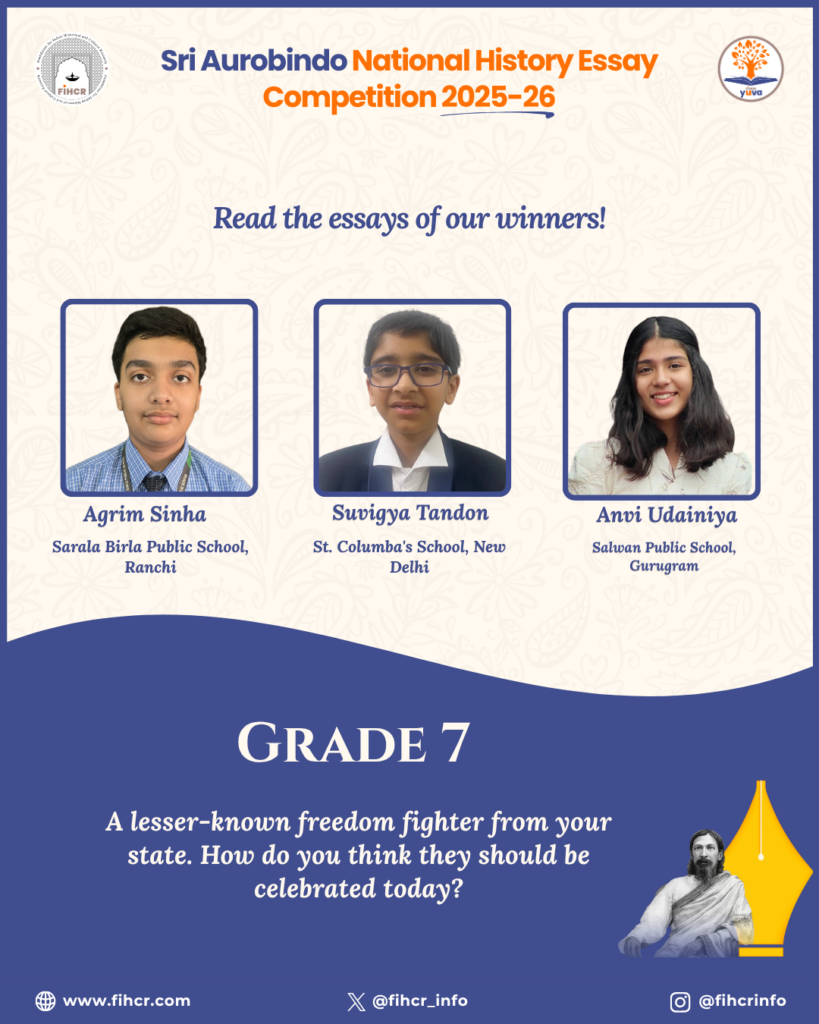
Class 7: A lesser-known freedom fighter from your state. How do you think they should be celebrated today?
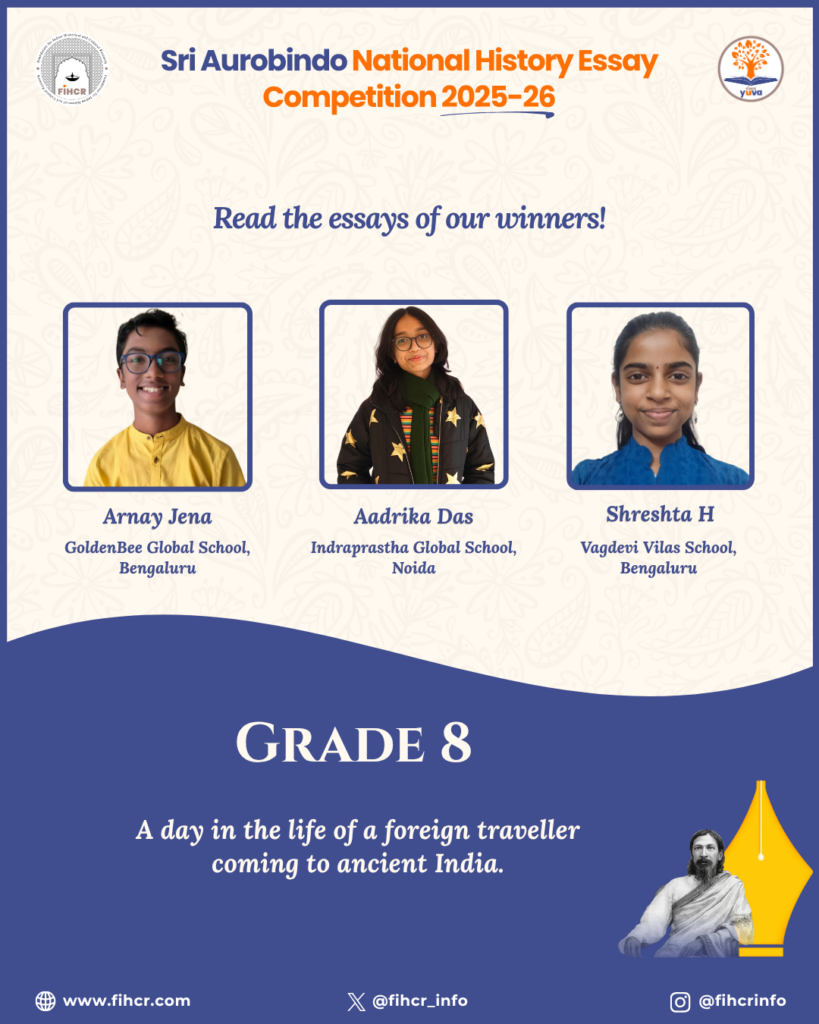
Class 8: A day in the life of a foreign traveller coming to ancient India.
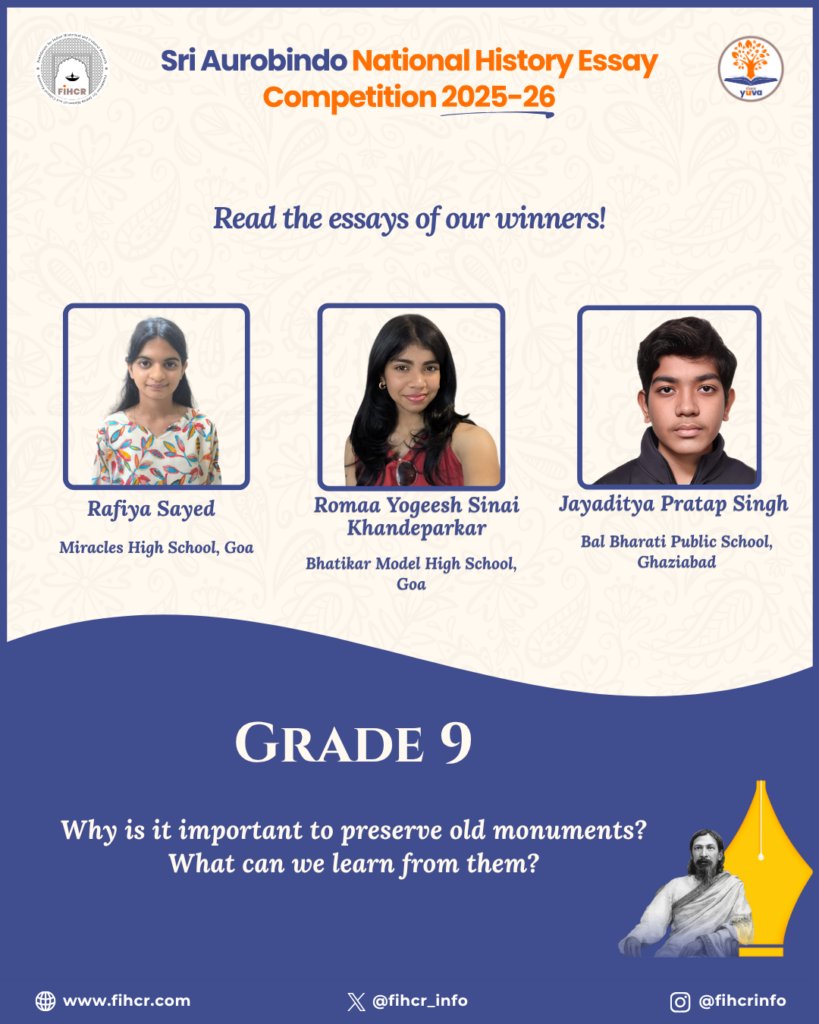
Class 9: Why is it important to preserve old monuments? What can we learn from them?
Language & Word Limit
The competition will be conducted in English for the year 2025-26. The word limit is as follows:
Grades 7 and 8: 600–800 words
Grade 9: 800–1000 words
Submission Process
- Schools may conduct an internal round of the competition from November 10 to December 15, 2025, and select one best essay per grade for submission to FIHCR.
- For the internal round, essay topics for each grade will be the same as the topics specified for the competition.
- The evaluation of essays may follow the criteria provided by FIHCR (see Evaluation Criteria).
- Essays should be original and written/typed under supervision within the school premises.
- The names and details of the selected students, along with their typed essays, must be submitted to FIHCR by the stipulated deadline.
Schools can now submit more than one essay per grade through this online form in Word and PDF format.
While there is no limit on the number of entries, essays must be submitted only through schools.
Resubmissions
Resubmissions will not be allowed.
Evaluation Criteria
The essays will be assessed on creativity, grammar, vocabulary, understanding of the topic, personal reflection and presentation of unique or lesser-known information. AI-generated and plagiarised entries will be rejected.
Announcement of Winners
The winners will be announced in April 2026 on our website and social media handles.
Prizes
Two winners from each group will receive a cash prize, a book, and a certificate. Selected essays will be featured in our upcoming anthology. All participants will receive digital participation certificates.
FIHCR Essay Anthology
FIHCR is proud to present the ‘Our Living Heritage, Essays by Young India’, an anthology of selected essays from the Sri Aurobindo Annual History Essay Competition 2024–25. Chosen from over 1500 entries representing 320+ cities, it features exceptional work from school students across India. These essays showcase original research, fresh perspectives, and a deep engagement with India’s historical and cultural legacy. This collection reflects Sri Aurobindo’s vision of nurturing inquiry, critical thinking, and a meaningful understanding of our civilisational journey, offering readers insightful and inspiring voices from the next generation.
Click here to get your copy today!
Timeline of Essay Competition
Details of the Competition:
- Start Date: November 10, 2025.
- End Date: January 30, 2026.
- Submission Timeline: December 15 to January 30, 2026
Please contact your school to participate in the competition.