
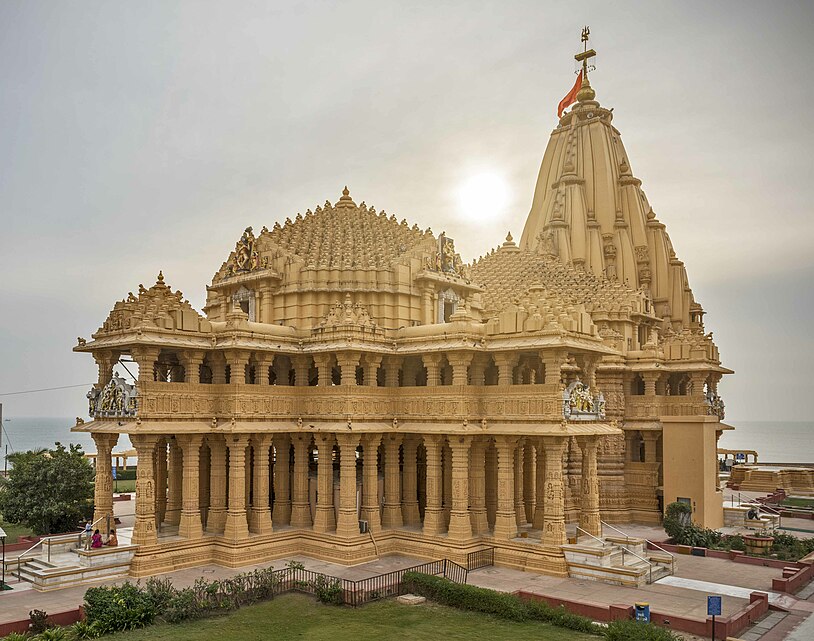
On May 8, 2026, the Somnath temple complex will host a one-day academic symposium titled “Somnāth: The Unconquered Soul of Bhārat,” bringing together scholars, practitioners, and public intellectuals from across the nation to engage with one of the most enduring sites in India’s civilisational landscape.
Organised by the Foundation for Indian Historical and Cultural Research (FIHCR) and Brhat, with the support and partnership of the Shree Somnath Temple Trust, the symposium forms part of the broader Somnath Swabhiman Parv. The occasion marks two significant milestones: a thousand years since the first recorded destruction of the temple by Mahmud of Ghazni, and the 75th anniversary of its Prana Pratishtha in independent India on May 11, 1951, an effort led by Sardar Vallabhbhai Patel and K. M. Munshi defying the opposition by Jawahar Lal Nehru.
Yet, to view Somnath merely through the lens of destruction and reconstruction is to miss the deeper arc of its historical and civilisational significance. Somnath has, for centuries, existed not just as a physical structure, but as a node of sacred geography, economic networks, ritual continuity, and cultural memory.
Historical accounts, ranging from the observations of Al-Biruni to later chroniclers and colonialera travellers, describe Somnath as a site of remarkable wealth, architectural sophistication, and ritual centrality. The temple’s location at Prabhas Patan, at the confluence of land and sea routes, made it a vital centre of pilgrimage as well as exchange. These accounts also suggest that the temple functioned within a wider network of sacred and material connections that extended far beyond its immediate geography.
Recent scholarship presented at the symposium builds on these insights to argue that Somnath cannot be reduced to episodic moments of rupture. Instead, it must be understood as a site of continuity, where memory, ritual, and institutional practices persisted even across periods of political instability.
Several research papers revisit Sanskrit literary traditions of the twelfth and thirteenth centuries, demonstrating how Somnath continued to be represented as an active centre of pilgrimage and patronage, long after the Ghaznavid campaign. These texts not only preserve memory but also reflect lived experience, documenting rituals, journeys, and forms of collective participation that sustained the temple’s presence across generations.
Other contributions turn to regional narratives and Indic literary traditions to examine episodes of resistance and recovery, challenging dominant historiographical frameworks that interpret temple desecration purely through political or economic lenses. By bringing Indic sources into conversation with Persian chronicles and modern historiography, these studies seek to present a more layered and comprehensive account.
Equally significant are papers that situate Somnath within broader frameworks of sacred geography and philosophy. Some explore how the temple functions as part of a wider network of tirthas, linking it to sites such as Dwarka and Girnar, while others examine the role of Advaita Vedanta and the intellectual traditions associated with Adi Shankaracharya in shaping a civilisational continuity that transcends material destruction.
The architectural dimension of Somnath also receives attention, with scholars arguing that reconstruction itself must be understood as a cultural practice, one through which memory is not merely preserved but actively rearticulated. In this view, Somnath’s history is not a linear narrative of loss, but a cyclical process of renewal.
The symposium’s thematic structure reflects this diversity of inquiry. It engages with Somnath as metaphor and memory; examines historical processes of destruction, resistance, and reconstruction; situates the temple within modern India’s nation-building efforts; and critically evaluates dominant historiographical narratives that have shaped public understanding of the site.
The event will be held at the Ram Mandir Auditorium within the Somnath temple complex and is open to the public. With an expected attendance of 200–300 participants, including students and scholars, the symposium aims to create a space for meaningful engagement beyond academic boundaries. The proceedings will also be live-streamed on Sahitya Tak.
The symposium will feature keynote addresses by Dr Anand Ranganathan and Senior Advocate J. Sai Deepak, alongside speakers including Dr Neerja A. Gupta, Prof. Kapil Kapoor (via recorded address), Shri Raghava Krishna, and Dr Vikram Sampath. Together, they represent a convergence of scholarship, public discourse, and institutional leadership.
At a time when historical narratives are increasingly contested, the Somnath Symposium offers an opportunity to engage with the past through evidence-based inquiry, while remaining attentive to the role of memory and meaning in shaping civilisational identity.
In returning to Somnath, the symposium does not merely revisit history; it seeks to understand how a civilisation remembers, reconstructs, and redefines itself across time.