
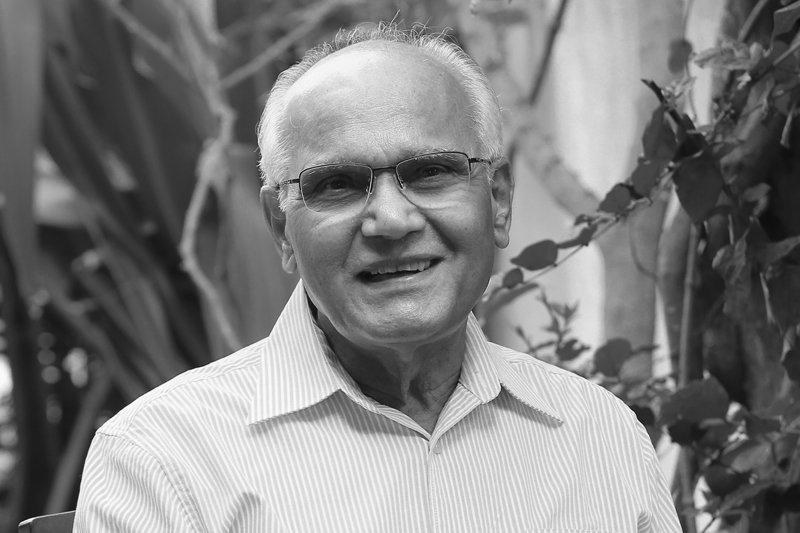
We recently hosted the inaugural edition of the FIHCR Annual History Awards on September 5, 2026, in New Delhi. Hon’ble Finance Minister Nirmala Sitharaman was the chief guest and also the keynote speaker for the S. L. Bhyrappa Memorial Lecture. I was on stage management duty, briefing the volunteers on their tasks for the event, when one of them asked, “Who is S. L. Bhyrappa?
I was mildly surprised. I looked around and realised that none of them knew the name.
“He was a giant of Kannada literature. He passed away last year,” I said.
“Oh, was he a famous historian?” another followed up.
Now that was a tricky question. I simply told them to look him up, but that question lingered in my mind. His readers will understand that the answer is: no, but sort of, yes.
Encountering S.L. Bhyrappa
During my undergraduate years, my idea of India was shaped largely by Anglophone writing. It was an India built out of books written in English, about India, but meant for an outside world: V.S. Naipaul, Vikram Seth, E. M. Forster, J. G. Farrell and later Amitav Ghosh, Salman Rushdie, Jhumpa Lahiri, and Kiran Desai. For a long time, I clung to novels like Midnight’s Children to show me the India that existed before I was born. It wasn’t necessarily a wrong picture, but it was a tinted one.
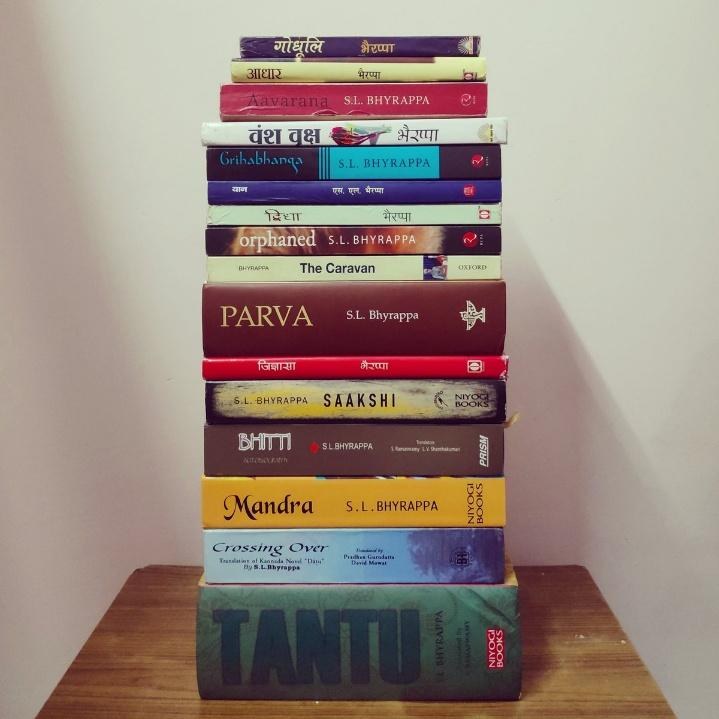
Then a strange shift happened in 2022. I was researching Sita’s trial-by-fire episode in contemporary myth-fiction novels when I came across the English translation of S.L. Bhyrappa’s Uttar Kaanda. I expected it to follow the familiar arc: Sita’s lament, Rama’s indifference, Lakshmana and Hanuman’s helplessness, Sita commanding a pyre to be built, Agni-deva descending, and Rama approving only after the test, claiming he always knew her purity but had to prove his queen’s fidelity to the public. Some books recount the episode as is; others frame it through the lens of patriarchy, victimhood, the follies of men, or societal pressures on women. Bhyrappa does something different. He has Lakshmana, the younger brother, talk sense into Rama, and Rama then holds Sita’s hand and circles the Agni thrice. She never sits on the pyre. Never does the traditional Agni Pariksha. Impressed, I began ” reading about Bhyrappa, exploring his essays and other works. Then I came to Parva, Saartha and Scion (Vamshavriksha) – English translations, of course, and I felt immense joy in reading about India – its stories, its cultures, its conflicts from an insider’s perspective, where the aim is not to criticise or build an India that is pre-approved; it is simply to present it truthfully. I felt like I had stumbled into an actual, unvarnished India.
Truth and Beauty
That refusal to soften reality makes his characters unforgettable. I again return to Sita in the Uttara Kaanda. In classical retellings or television serials, where do we first meet her? At her Swayamvara, radiant as a goddess? As the queen of Ayodhya? Or as the abducted wife of Rama? In Bhyrappa’s Uttara Kaanda, we meet her in Valmiki’s ashram as an exhausted mother, growing impatient and frustrated because her infant won’t drink her milk. The intimacy of that opening is what hooked me to read further. By stripping away her divine aspects, he doesn’t diminish Sita; instead, he makes her human, prone to folly, like all of us. She becomes someone a mother today can recognise immediately. He does the same in Parva, stripping the Mahabharata of divine theatrics so we are left with the cold, psychological devastation of human choices.
In Saartha, he pulls off something extraordinary: he resurrects eighth-century India. I had read historical summaries of Adi Shankara, Kumarila Bhatta, and the intellectual debates at Nalanda, but I could never truly imagine that world. Bhyrappa once said that he wanted Saartha to do for ancient India what Walter Scott’s novels did for historic Scotland. Placed inside a moving caravan, that vanished world comes alive with its nuances, both physical and philosophical.
History and Memory
Unless one pursues it professionally, history usually fades after Harappa and Mohenjo-daro, the Guptas, and a handful of medieval dynasties. We forget the history we studied as students ” because our minds rarely hold onto dry facts. We might recall the image of the Great Bath or the Dancing Girl, but ask us when the Harappans actually lived, and we feel lost. Enter, historical fiction. It builds worlds, images, sensory details; it constructs a memory of an experienced, if not lived, reality. The intention is not to dismiss the discipline of history or undermine its rigour; empirical scholarship is indispensable. It has its place, and so does historical fiction. In the foreword for Parva, he writes, ‘I must confess that I have no adequate evidence to confirm or disconfirm, beyond dispute, the existence of Dwaraka, referred to by Dr Thaker. Moreover, that is not a matter of interest to me…. But Dwaraka had become part of my internal experience… I felt as if I had actually been there in Dwaraka, and knew like the back of my hand its streets and lanes. I felt confident that I could negotiate them without difficulty and with skill.’
And when you read Parva, you too will feel the same. This is the power of historical fiction. Until I came across Hilary Mantel’s Wolf Hall, I had never read about Tudor England. But now I feel as if I know Thomas Cromwell a little too well. Bhyrappa has done for India what writers like Mantel have done for Britain. Are they historians? In the technical sense, no. But they are perennial researchers sitting at the intersection of history, literature and cultural memory.
Remembering Bhyrappa
In his essay, Why Do I Write? (Naaneke Bareyuttene?), Bhyrappa writes that early in his life, he rid himself of the ‘mad notion’ that literature should bring about a transformation in society. That struck me as one of the most honest statements a writer could make, especially in a country like ours. When people talk about ‘Indian literature’ changing society, which literature do they even mean? Kannada? Marathi? Gujarati? Bengali? We are speaking of dozens of distinct literary universes. Bhyrappa recognised that turning fiction into an instrument for social change flattens it. Literature in our country might have fuelled revolutions (Vande Mataram by Bankim Chandra ” Chattopadhyay; Jayostute by V.D. Savarkar), but Bhyrappa believed its real aim is to portray the most raw, vulnerable aspects of human sensibility, to heighten them, and to chase the truth wherever it leads.
Bhyrappa was never interested in translating India for Western approval. This is also why his work belongs to decolonial literature, rather than merely “post-colonial.” Reading him through Ngũgĩ wa Thiong’o’s Decolonising the Mind, you realise that true decolonisation isn’t just reacting to the British or explaining yourself in imperial English. Decolonial literature refuses to let the colonial memory dictate how you see yourself and your country.
During the memorial lecture, Hon’ble Finance Minister Nirmala Sitharaman highlighted his stubborn refusal to take any side except the truth. That stubbornness matters immensely today. We are often told that great literature should detach itself from the writer once published, leaving only the reader’s interpretation. But in the case of Bhyrappa, his search for truth and beauty keeps him firmly present and alive. His voice doesn’t fade. For readers like me, who grew up depending on Anglophone literature for their idea of India, entering his work is an unsettling, yet necessary awakening. It offers an India that is neither exoticised nor idealised, but relentlessly, unapologetically lived.
© 2026 Foundation for Indian Historical and Cultural Research (FIHCR). All rights reserved. This article is the intellectual property of the Foundation for Indian Historical and Cultural Research (FIHCR). No part of this article may be reprinted, reproduced, or transmitted in any form or by any means, whether electronic, mechanical, photocopying, recording, or otherwise, without the prior written permission of FIHCR.