
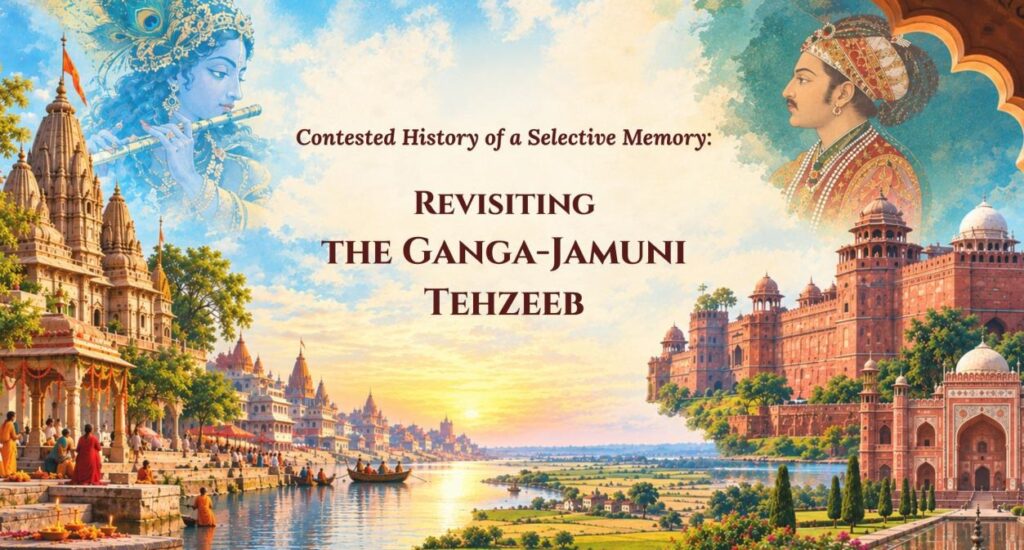
This article examines the politics of what some historians have described as the “Ganga- Jamuni tehzeeb”, a poetic Awadhi phrase referring to the sharing of food, festivals, language, and customs for centuries. It argues that the term “Ganga-Jamuni Tehzeeb” functions less as historical description than as a historiographical label applied to what was, in fact, Timurid culture. Scholars have interpreted Hindu-Muslim cultural syncretisation as producing a new culture after the decline of the Mughal Empire, but this article questions that reading. It shows that the cultural landscape of the Ganga and Yamuna regions had long been shaped by distinct religious and ecological formations before Muslim rule. The religious and cultural landscape of Mathura and the wider Braj region along the Yamuna was associated with Lord Krishna and constituted an important sacred landscape for Hindus.
The region was characterised by numerous temples, sacred groves, devotional practices, bhajans, pilgrims, and ghats along the Yamuna. Similarly, the wider Ganga basin constituted one of the most fertile and agriculturally productive regions of northern India. The region’s ecological and agricultural potential played an important role in the emergence of the janapadas and mahajanapadas. These developments were accompanied by increasingly complex political institutions, economic networks, religious traditions, urban centres, and social structures, ultimately producing a well-developed socio-cultural landscape long before the establishment of Muslim kingdoms. Moreover, the city of Banaras on the banks of the Ganga emerged as one of the most sacred Hindu cities dedicated to Lord Shiva.
In contrast, medieval history, including the Mughal period and the regional kingdoms emerged after the decline of the Mughal Empire, such as the Awadh state, was marked by forts, palaces, gardens, tombs, and royal courts, particularly those constructed in red sandstone. Some historians have therefore presented the Yamuna and the Mughal court as connecting elements between these different cultural landscapes. Similarly, Akbar’s practice of consuming water from the Ganga has sometimes been cited as evidence of cultural accommodation and an emerging composite culture.
However, an important historiographical question arises: did a cultural formation actually known as “Ganga-Jamuni tehzeeb” exist before the foundation of the Awadh state or during the Mughal period, or is this a later historiographical construction imposed upon the past? There is no evidence in the recorded statements of the Mughal emperors or in contemporary administrative and literary documents of a clearly articulated concept called “Ganga-Jamuni tehzeeb.” The expression appears to have gained prominence in late-twentieth-century historiography, when some historians began using it to describe the Mughal court and the post-Mughal regional kingdom of Awadh as centres of Hindu-Muslim cultural interaction, composite traditions, music, dance, education, literary production, ruling-class structures, and material culture. This study therefore treats the term as a later interpretive framework rather than an established historical category.
Our principal investigation is whether the “Ganga-Jamuni Tehzeeb” had earlier cultural elements and was entirely new; if not, we first need to discuss the cultural developments under the Mughals to understand the extent of Hindu-Muslim cultural syncretization. To run an empire with a large non-Muslim population, the ruler was led to adopt particular customs, patronise artistic traditions, employ people from different religious communities, or accommodate local practices for political and administrative reasons without necessarily creating or subscribing to a distinct composite cultural ideology. Thus, such an act cannot be categorised as amalgamating two cultures; rather, it is a way to cope with the situation at a given point in time.
It is therefore essential to examine the actual cultural and political arrangements created under Mughal rule. Rather than assuming that the Mughal period produced a “Ganga-Jamuni tehzeeb,” asks what evidence exists for Mughal political practices, religious policies, court culture, architecture, art, music and dance, literary traditions, language, education, social structures, and relations with existing regional traditions. It also examines the extent to which Mughal rulers preserved, appropriated, transformed, or displaced the pre-existing cultural structures of the Ganga-Yamuna region.
The Timurid Traditions and Mughal Identity in India
The establishment of Mughal rule in India was closely tied to Timurid traditions and to the dynastic identity of its founder, Babur, a fugitive ruler from Ferghana and Samarqand. After his victory at the First Battle of Panipat in 1526, Babur established Mughal power in India. His early political conduct reflected his religious convictions and the Timurid political traditions to which he continued to lay claim, showing how dynastic identity shaped the new regime. After his victory at Panipat, Babur sent the noble Naytuzar to Mecca with a copy of the Qur’an written in his own hand, presenting it as an offering and expressing gratitude to Allah for granting him sovereignty in India. Before his confrontation with Rana Sanga at Khanwa, he assumed the title of Ghazi, framing his campaign in explicitly religious terms.
Babur also took considerable pride in his Turkish identity and in his descent from Timur. After the Battle of Khanwa, Babur went to the village of Sikri near Agra, where he celebrated his victory with his Turani nobles. On 11 February 1527, he renamed Sikri Shukri as an expression of gratitude to Allah and declared his victory a fath (victory) and himself a Padshah of Islam. He then constructed a garden at Sikri called Bagh-i Fath, commemorating his victory and reflecting the Persianate cultural traditions and aesthetic values with which he was familiar. The garden incorporated a carefully planned layout, a well, and a hammam, and it subsequently became known as Baburi Bagh. As Babur’s political and religious outlook gradually transformed, he became more familiar with India’s people, environment, climate, and cultural conditions.
Although he had described Rana Sanga as a kafir during the Battle of Khanwa, by the time of his campaign at Ujjain he appears to have developed a more pragmatic understanding of Indian society and its political circumstances. These political realities, the social composition of his subjects, and the need to consolidate his newly established authority compelled Babur to moderate the overt projection of certain aspects of his Timurid and Ghazi identity. The memory of Timur’s invasion of India, during which large numbers of people had been enslaved and taken to Samarqand, remained deeply embedded in the popular memory of the Indian population. Consequently, Babur’s army generated considerable fear among the local population, prompting many people to flee towards the forests at the sight of his forces.
In his memoirs, particularly his accounts of Kabul, Ferghana, and Samarqand, Babur presents his Timurid identity as a source of distinction among the Safavid, Uzbek, Turani, Turko-Mongol, and Iranian elites with whom he interacted. In the Indian context, however, this Timurid identity presented a political dilemma. Babur therefore sought to construct a distinct basis of legitimacy for his rule in India. Rather than presenting himself primarily as a successor to Timur, he increasingly represented himself as the third Muslim conqueror of India after Mahmud of Ghazni and Muhammad Ghori. This shift is significant because it clarifies how Babur balanced dynastic legitimacy with the demands of rule in India. Babur died in 1530, after which his son Humayun succeeded him and ruled until 1540.
In 1540, Humayun was defeated by Sher Shah Suri, the ruler of Bengal, and was forced to retreat to Iran. With the military assistance of the Safavid ruler Shah Tahmasp, Humayun eventually returned to India and re-established Mughal rule in 1555. Following Humayun’s accidental death in 1556, his son Akbar ascended the throne at Kalanaur in Punjab and assumed control of the Mughal state. Akbar is widely regarded as the principal consolidator and institutional founder of the Mughal Empire in India, inheriting his predecessors’ Timurid dynastic identity and traditions. This inheritance linked Akbar directly to the Timurid legacy, raising an important historiographical question: How did Akbar negotiate, preserve, or transform the Timurid dynastic identity and traditions inherited from his predecessors while establishing a durable imperial order in the Indian context?
Akbar’s Adaptation to the Indian Context The deposition of Bairam Khan in 1560 and the death of Maham Anga in 1562, which brought an end to the period of Petticoat Government, mark the beginning of Akbar’s effective personal rule. Thereafter, Akbar increasingly assumed direct control over the affairs of the Mughal Empire. As he expanded the Mughal Empire by adapting to India’s prevailing political circumstances, he did not abandon his Timurid identity or his affinity for Persianate culture and traditions. His policies therefore reflected accommodation rather than a complete rejection of his inherited cultural and dynastic traditions, highlighting the balance at the centre of his rule. This balance is central to understanding his adaptation to India. Nevertheless, Akbar did make certain changes in his personal identity, practices, and modes of conduct in response to the Indian environment.
These modifications were necessitated by India’s climate, social conditions, political circumstances, and cultural realities. His changing conduct thus appears closely connected to the political requirements of his expanding empire and to the adaptation of the Timurid identity he had inherited. This connection shows how adaptation shaped his rule in India.
Mughal Painting and Architecture: The Continuity of Timurid and Persianate Traditions
As soon as Akbar assumed direct control of the Mughal administration, he established a painting atelier (tasvir-khana) as one of the first major cultural institutions of his court. Several accomplished artists who had served under Humayun, particularly Sayyid Ali, Abd al-Samad, Mir Musavvir, and Dost Muhammad, were associated with the imperial atelier. These artists were highly skilled in Persian calligraphy, manuscript illustration, and figurative painting. Building on these painters’ practices, Akbar continued to employ foreign Iranian and Turani painters and artists at the Mughal court, while also bringing Indian artists into the imperial atelier, where they were trained under these masters’ supervision. Indian painters gradually adopted elements of the Persianate artistic style, partly through competition and interaction with Iranian and Turani artists and partly because mastery of this style provided opportunities for patronage, recognition, and advancement at the imperial court. This process established the Persianate basis of Mughal artistic culture.
The imperial painting atelier established under the supervision of Sayyid Ali and Abd al- Samad also demonstrates the interaction of Persianate, Central Asian, and Indian artistic traditions. Architectural and decorative programmes incorporated geometric designs, vertical and linear patterns, floral and vegetal motifs, representations of animals and birds, natural landscapes, Central Asian visual elements, and Quranic verses. These motifs were employed extensively in imperial decoration, showing how Mughal art absorbed and reordered these traditions.
Mughal architecture similarly reflected a combination of inherited Timurid and Persianate traditions with elements encountered in the Indian environment. Many buildings incorporated jalis (perforated stone screens), double domes, Islamic arches and mihrabs, animal motifs on architectural elements, and representations of birds, including falcons. At the same time, Central Asian influences associated with gardens, the Timurid tent-dwelling tradition, and contemporary visual culture contributed to distinctive architectural forms. The extensive use of tiles, plaster decoration, and mosaic work further reinforced this continuity in Mughal architectural aesthetics.
Another important feature of Mughal architectural planning was the prominence given to the chahar-bagh and hasht-bihisht garden layouts. These gardens were organised according to carefully designed geometric patterns. The architectural complex associated with Humayun’s Tomb, for instance, was conceived within a garden setting inspired by the Timurid garden tradition. Subsequently, Kashmir’s landscape helped Mughal rulers develop and institutionalise the Timurid garden aesthetic in the Indian subcontinent. Consequently, numerous gardens were constructed in Kashmir and Lahore, often in association with architectural structures. In Kashmir, settlements associated with gardeners and horticultural specialists developed in areas such as Bagh-i-Pura, Begampura, and Shahdara, reflecting the centrality of garden culture in Mughal patronage.
Mughal painting also developed a distinctive visual vocabulary. Paintings frequently depicted expressive faces, carefully rendered gestures and postures, rugged and undulating Central Asian landscapes, verdant gardens, flowing rivers and streams, animals, birds, and human figures. These elements, rendered through a rich range of colours and carefully controlled compositions, marked a recognisable Mughal style.
Timurid Genealogy, Divine Light, and Mughal Imperial Representation
Continuing the practice of preserving and projecting their dynastic traditions, the Mughal rulers commissioned illustrated versions of important Timurid and Mughal historical works. Among the earliest projects was illustrating the three parts of the Hamzanama, along with works such as the Baburnama and Timurnama. The illustration of the approximately 1,400 paintings of the Hamzanama took nearly fifteen years to complete. In addition to artists such as Sayyid Ali and Abd al-Samad, painters including Aqa Riza, Mirza Ghulam, and others played an important role in establishing Persianate aesthetic conventions at the Mughal court, extending from the Safavid artistic tradition to the court of Jahangir. The Mughal emperors Akbar and Jahangir also commissioned paintings depicting their ancestors in various settings and forms. Such representations were not merely artistic exercises; they helped construct and visualise Mughal dynastic memory and authority.
In 1585, Akbar commissioned a painting of Rani Alanquwa, the supposed founder of the Mongol lineage, thereby associating Mughal genealogy with a broader Turko-Mongol dynastic tradition. The queen is depicted in her tent, pregnant and illuminated by rays of sunlight. According to the dynastic narrative, her three sons transmitted this divine radiance through their descendants. Within this Persianate genealogical tradition, the numbers 6, 8, and 10 held particular importance. Akbar was represented as the eighth ruler descended from Timur, while Shah Jahan was presented as the tenth. Both Akbar and Shah Jahan, following Babur’s model, used the symbolism of divine light (farr-i izadi) to represent their sovereign authority. The imagery of light emerging from the body or womb became a visual metaphor for divinely sanctioned kingship and dynastic continuity. Abul Fazl accordingly described Akbar as possessing farr-i-izadi, the divine radiance emanating from God, which provided the emperor with a distinctive form of spiritual and political legitimacy. Akbar’s possession of this divine radiance was also associated with his claimed authority to provide spiritual guidance.
This conception of sovereignty was further represented through imperial objects and visual symbolism. The famous Peacock Throne, for instance, was decorated with a ruby associated with the Iranian ruler Shah Abbas, and the names of Timur Sahib-i Qiran, Akbar, Jahangir, and Shah Jahan were inscribed on it. These inscriptions symbolically connected the Mughal emperors with the Timurid genealogical tradition and the wider Turko-Persian conception of universal kingship, reinforcing imperial legitimacy.
From Akbar through Shah Jahan, the Mughal emperors repeatedly represented their political identity through titles, genealogical claims, and dynastic affiliations such as Sahib-i Qiran, Sani, and Gurkan—the latter signifying descent from the Chinggisid tradition through marriage. Abul Fazl, in his writings, praised Akbar by referring to him as the “lamp” of the illustrious Gurkanid house, thereby presenting the emperor as the bearer and transmitter of dynastic glory. Jahangir, meanwhile, incorporated the sun and its reflection as important symbols in his imperial portraits, thereby associating his sovereignty with cosmic and divine radiance. Shah Jahan similarly had the title Sahib-i Qiran Sani inscribed on his coins, explicitly connecting his authority with the Timurid conception of kingship.
The Mughal architectural tradition also continued to display Central Asian and Persianate influences. Mughal buildings incorporated Quranic calligraphy, jalis, floral and vegetal motifs, and geometric designs, all executed with considerable sophistication. From the reign of Jahangir, the use of pietra dura and coloured stones became increasingly prominent, while under Shah Jahan the extensive use of marble became a defining feature of imperial architecture.
Thus, from Akbar to Shah Jahan, Mughal rulers employed painting, architecture, genealogy, imperial titles, inscriptions, symbols of divine light, and material culture to articulate and reinforce their Timurid dynastic identity. Persianate and Central Asian artistic conventions were not merely decorative elements; they functioned as important instruments through which Mughal sovereignty, genealogy, legitimacy, and imperial identity were represented. The cultural world of the Mughal court therefore needs to be understood not simply as a spontaneous “composite culture,” but as a deliberate process of preserving, adapting, and projecting a distinct Timurid-Persianate imperial tradition within the Indian political and cultural environment.
Persian as the Language of Mughal Administration and Court Culture
In 1570, Akbar declared Persian the official language of the Mughal Empire. To understand this decision, consider the linguistic practices of the preceding Afghan regimes, particularly the Sur and Lodi dynasties, which had adopted Hindavi as an important language of administration and public communication. Consequently, until around 1570, a considerable portion of Mughal revenue and administrative documents continued to be written in Hindavi. Once Persian was established as the official administrative language, Todar Mal, under Akbar’s direction, ordered revenue records and administrative documents translated into Persian.
The adoption of Persian had significant consequences for the Mughal Empire’s administrative structure. Many Hindu officials, particularly Khatris and Kayasthas employed as scribes in the revenue administration, quickly acquired proficiency in Persian. Similarly, Hindu officials working in other departments of the administration also learned Persian. In this sense, adopting Persian led to the Persianisation of sections of the Hindu administrative and scribal elite, who increasingly became proficient in the language of the imperial bureaucracy. Persian, however, was not merely an administrative language; it also marked elite culture and social distinction. Its increasing importance appears to have widened the cultural and administrative distance between the ruling establishment and sections of the population who lacked access to Persian education. Moreover, although the Mughal court gave Persian a privileged position, other Indian languages did not receive comparable institutional patronage as imperial court languages.
This raises an important question concerning the nature of Mughal cultural policy: to what extent did the Mughal state encourage the development of India’s existing linguistic traditions, and to what extent did it privilege Persianate cultural forms? Evidence suggests that Sanskrit continued to be used by Jain and Hindu intellectuals for literary and religious purposes. Still, this use did not necessarily reflect systematic state patronage of Sanskrit as an official administrative language. At the same time, many Hindu and Sanskrit works were translated into Persian during the Mughal period. However, these translations should not automatically be interpreted as evidence of an equal cultural synthesis.
Rather, in several instances, Indian narratives and intellectual traditions were reinterpreted through Persianate literary conventions and conceptual frameworks. Indian heroes and cultural figures could consequently be represented within categories and literary forms familiar to the Persianate world. Persian thus became not merely a medium of communication but also an important vehicle for transmitting Persianate cultural values, literary conventions, political concepts, and courtly traditions. This process deserves particular attention when assessing the nature of cultural interaction under Mughal rule.
Akbar himself encouraged the translation of important works associated with his dynastic and political heritage. Under his patronage, the Baburnama, the Humayunnama of Gulbadan Begum, the Tazkira of Humayun, and the Tazkirat-ul-Waqiat were translated from Turkish into Persian. Through the imperial translation bureau and the patronage of poets and scholars, Akbar ensured that Persian remained central to the intellectual and cultural life of the Mughal court. Consequently, a large body of Mughal administrative, political, literary, and historical writing is available primarily in Persian. Important works such as the Ain-i Akbari, Akbarnama, Tabaqat-i Akbari, Tuzuk-i Jahangiri, Padshahnama, Maasir-i Alamgiri, and related administrative records, chronicles, and memoirs were composed in Persian.
Persian also extended to members of the Mughal royal household. Several Mughal princesses and royal women were accomplished Persian writers and poets. Among them were Salima Sultan Begum, Gulbadan Begum, Jahanara Begum, and Zeb-un-Nissa, who participated in Persian literary culture through writing and patronage. Their contribution demonstrates that Persian had become deeply embedded not only in the bureaucratic apparatus but also in the intellectual and cultural life of the Mughal elite. This linguistic and cultural arrangement continued for several centuries. Only in 1835, under British rule, was English officially promoted in place of Persian as the principal language of higher administration and education.
The history of Persian under the Mughals therefore presents an important case for examining the character of Mughal cultural policy. Persian functioned as an administrative language, a language of elite culture, a medium of historiography, and a vehicle for transmitting Persianate political and cultural values. The growing prominence of Persian also transformed sections of the existing Indian administrative elite, particularly Hindu scribal groups, who acquired Persian education and became integrated into the Persianate bureaucratic system. Thus, rather than assuming that the Mughal period automatically produced a uniformly “composite” cultural order, it is necessary to examine the asymmetries of cultural patronage:
which languages received official recognition, which literary traditions received imperial support, and how indigenous intellectual traditions were translated and represented within the Persianate framework. Such an examination is essential for assessing whether the concept of “Ganga-Jamuni tehzeeb” adequately describes the cultural realities of Mughal India or retrospectively simplifies a far more complex relationship between Persianate imperial culture and pre-existing Indian traditions.
Mughal Patronage of Persianate Scholars and the Iranian Influence at Court
Although descended from Turkic-speaking ancestors, the Mughal rulers continued to show a strong affinity for the Persianate culture of Central Asia and Iran. This attachment was particularly evident in their patronage of the Persian language and scholarship. Akbar, for instance, commissioned a register of Persian scholars associated with Iran and invited learned men from the Iranian world to participate in the intellectual life of the Mughal court. In 1585–86, Akbar sent Hakim Humam to Iran and Turan specifically to invite Persian scholars and ulama to India. This policy facilitated the migration of scholars from the Iranian cultural sphere to the Mughal Empire and strengthened the Persianate intellectual character of the imperial court.
Among those who came to India was Chalpi Beg, who subsequently served as the principal teacher at the Shahi Madrasa in Agra. Similarly, when the celebrated scholar Mir Sharaf Amuli arrived in India, Akbar personally received him. These instances demonstrate the importance the Mughal court attached to scholars trained in Iranian and Persianate intellectual traditions. From the reign of Akbar through that of Shah Jahan, the Mughal court also reserved the prestigious position of Malik al-Shuara (Poet Laureate) primarily for Persian poets. Those who held or were associated with this distinction included Ghazali, Mashhadi, Husain Sanai, Talib Amuli, Kalim Kashani, Shahdi, and Faizi. Except for Faizi, most of these poets were Iranian.
The evidence therefore suggests that Persianate culture constituted a major component of Mughal court culture. The Mughal rulers did not simply inherit Persian as an administrative language; they actively recruited Persian-speaking scholars, patronised Iranian poets, invited intellectuals from Iran and Central Asia, and incorporated Persianate literary and scholarly traditions into the empire’s institutions. This raises an important question for the study of Mughal cultural history: whether such developments should be interpreted primarily as evidence of a “composite” Indian culture or as the continued institutionalisation of a Persianate imperial culture within the Indian political environment.
Persianisation of Education under the Mughals
Babur’s attachment to the Persian language was not confined to scholars and poets at the Mughal court; it also extended into the wider intellectual and educational sphere. This process was further strengthened under Akbar, who promoted the Persianisation of education and organised the Mughal Empire’s educational system broadly along an Islamic institutional pattern. At the primary level, education was provided through maktabs, which were generally attached to mosques. Instruction traditionally began at approximately four years, four months, and four days of age, with the recitation of the word Bismillah. Akbar introduced a more systematic curriculum for the maktabs. Students were initially taught the alphabet, reading and writing, letter formation, and basic literacy, followed by prose and poetry, memorisation of verses, formal reading, memorisation of Quranic passages, and practical writing exercises.
The curriculum included both religious and rational sciences. Religious instruction comprised the Quran, Hadith, Tafsir, Islamic jurisprudence, and Fiqh, while the rational sciences included disciplines such as medicine, history, geography, and economics. Knowledge of the Quran remained an important component of the curriculum. The Mughal court also patronised educational institutions. In Delhi and Agra, the emperor appointed teachers to royal educational institutions. Some of these teachers were scholars who had migrated from Iran, such as Chalpi Beg.
Following elementary education in the maktab, students could proceed to higher learning in madrasas. Many maktabs and madrasas teaching Persian and Islamic learning were established or patronised by members of the ruling elite. These institutions sometimes provided facilities such as hostels, residential accommodation, and scholarships. Institutions associated with Mughal patronage included the madrasa established by Maham Anga, the Madrasa-i Begum or Khair-ul-Manazil (1561), the Fatehpur Sikri madrasa established for the education of the royal princes under the supervision of Shah Mir, and the Madrasa-i Abul Fazl. Numerous maktabs were also established across the empire’s twelve subahs. Jahangir subsequently established a royal regulation whereby the wealth of deceased merchants and affluent individuals without heirs could be appropriated for educational purposes. Such measures demonstrate the continuing role of state patronage and elite endowments in sustaining the empire’s educational infrastructure.
Hindus, particularly those who entered the Mughal administrative system, also received education in these maktabs and madrasas. Their knowledge of Persian became increasingly important for participation in the imperial bureaucracy. The educational curriculum included not only linguistic and religious instruction but also ethical and moral texts. Students were required to study works dealing with ethics, moral conduct, social obligations, and appropriate behaviour, alongside other prescribed texts.
Thus, from Akbar to Aurangzeb, Mughal rulers continued to promote educational institutions within the framework of their Persian-language and Timurid educational traditions. The expansion of maktabs and madrasas helped spread Persian linguistic and literary culture beyond the immediate circle of the Mughal court. It helped create a Persian-educated administrative and intellectual elite.
From the perspective of the broader cultural argument, however, an important distinction is needed. The participation of Hindu students and officials in Persian educational institutions demonstrates cultural interaction and administrative adaptation, but it does not necessarily establish a deliberately formulated “Ganga-Jamuni tehzeeb.” Rather, it may indicate the incorporation of sections of the existing Indian social elite into a Persianate educational and bureaucratic framework created and patronised by the Mughal state.
Persianate Influence on Mughal Music, Dress, and Cuisine
Babur’s attachment to his Timurid ancestry was expressed not only through his patronage of the Persian language, poetry, scholarship, and education, but also through the composition of the Mughal court and its musical traditions. Akbar’s appointment and patronage of Iranian musicians and artists at the imperial court further reinforces this Persianate orientation. Abul Fazl lists twenty-six musicians in the Ain-i Akbari; six were from Khurasan, and one was from Herat. He also states that the finest singers were Iranian and the best poets were from Khurasan. Similarly, Badauni praised the poet Liwai Pirzada Sabzwari, describing him as a distinguished court musician and performer.
Akbar himself was an enthusiastic patron of music and enjoyed performances of Rumi’s Masnavi and the poetry of Hafiz. The emperor’s esteem for Iranian artists and musicians is also reflected in the presence of figures such as Khan Inayat, Mir Muhammad Hashim, Iskandar, and others among the Mughal mansabdars. At the same time, Akbar did not exclude Indian musical traditions from his court. He gave prominent positions to accomplished Indian musicians such as Tansen and Baiju Bawra, who were recognised for their mastery of Indian classical forms, including dhrupad and khayal. Akbar conferred upon Tansen the title “Miyan” and included him among his celebrated Navratnas.
The account further claims that Ramtanu Pandey, better known as Tansen, adopted Islam and that his descendants continued to serve the Mughals as musicians for generations. While such claims require careful evaluation against contemporary evidence, the broader presence of Indian musicians at the Mughal court shows that imperial patronage shaped the empire’s musical culture through both Persianate and Indian traditions.
Dress and Material Culture
Akbar’s cultural orientation was also visible in dress and courtly material culture. His father, Humayun, is described as wearing a tall woollen cap associated with Central Asian and Baluch traditions. Akbar himself followed Islamic conventions for hair and wore a small turban to gather his hair. He also wore garments made from brocaded silk. According to Abul Fazl, Akbar adopted and patronised a variety of Persianate and Central Asian patterns and styles of clothing, reflecting the traditions inherited from his dynastic background. These included garments and forms such as jama, sarband, peshwaz, qaba, shah-azida, ghadar, huta, qalami, fargul, chaman, sajani, nimtana, postin, kulah, shabrār, salwar, paijama, nadri, ulbaka, kurta, tuz, achkan, choga, charq, libada, and kalabanub. Central Asian and Persianate traditions substantially influenced the patterns and designs of these garments. Rich colours, including red, black, and turquoise, were frequently employed. In addition, textile designs featured natural and landscape motifs associated with Central Asian visual culture. Alongside silk, garments embroidered with zari incorporated precious stones and gold and silver threads, demonstrating the luxurious material culture of the Mughal court.
Cuisine and Culinary Traditions
The influence of the Mughal rulers’ Central Asian and Persianate heritage was also evident in their culinary preferences. In addition to indigenous Indian foods, Mughal rulers patronised and consumed dishes such as kebabs, korma, richly spiced meat preparations, biryani, and pulao. These dishes became important components of elite cuisine and subsequently formed part of the broader culinary traditions associated with Mughal culture. Taken together, the evidence from music, dress, and cuisine shows a complex cultural process. Mughal court culture was neither entirely Central Asian or Persian nor simply indigenous Indian. The Mughal rulers brought with them Timurid, Turko-Mongol, Central Asian, and Persianate traditions, which they consciously maintained through patronage, court institutions, dress, cuisine, music, and the arts.
At the same time, Indian cultural forms—including Indian classical music and local artistic practices—were incorporated into the imperial establishment. Consequently, these examples should be examined carefully before being subsumed under the modern category of “Ganga-Jamuni tehzeeb.” The presence of Indian musicians, administrators, artists, and cultural practices at the Mughal court demonstrates interaction and accommodation. Still, interaction alone does not necessarily establish a consciously formulated composite cultural ideology. The more important historical question is how these different traditions were incorporated, under whose patronage, and within what political and institutional framework.
Decline of the Mughal Empire and the emergence of Awadh State
After Aurangzeb’s death, the Mughal Empire began to decline, and Awadh, a province (suba) of the Mughal Empire from 1722 A.D., became independent in practice. The first Nawab of Awadh was Saadat Ali Khan, whom the Mughal Emperor Muhammad Shah appointed. Even after Awadh became independent in practice, the Nawabs kept Mughal titles and culture. This is why we discuss Mughal political and cultural traditions in detail. As the Mughal Empire declined, Lucknow became a safer zone for artists, poets, and chefs, and they moved from Delhi to Lucknow. The Nawabs continued Mughal practices: Persian remained the court language; Mughal food items such as Dum Pukht, Biryani, Kebab, and Korma continued with refined tastes; and they built Imambaras, arches, and domes in the same Mughal architectural style.
The etiquette—Adab, Tehzeeb, and mushaira—was all borrowed from the Mughal courts. However, though Awadh was a rich state, it could not provide patronage at the same level as the Mughal court. Moreover, after Aurangzeb’s death, the Mughal rulers were stuck in handling attacks and succession disputes, so religious hatred towards non-Muslims took a backseat. Thus, the non-Muslim population got a chance to practice their cultural traditions on a larger scale. Holi, Diwali, Ramleela, and folk music became common and were celebrated on a large scale, as no one restricted them. Historians started calling this development a mix of two cultures and called it the Ganga-Jamuna Tehzeeb.
They forgot that Mughal rule was very suppressive and did not allow Hindu cultures and traditions to flourish; throughout the article, we see that the Mughals were only interested in promoting and adopting Persian traditions. Therefore, the decline of the Mughal Empire became a chance for Hindu revivalism, where Awadhi, which is the native language of the region and a dialect of Hindi, spoken in Ayodhya, Lucknow, Barabanki, Sultanpur, etc., became very popular as the migrants used it to express their artistic skills, as their patrons changed. Local Rajas, zamindars, and temples got more freedom to patronise their own language, so Awadhi folk songs, Holi, Ramleela, and Sawan stories flourished more openly.
After the decline of a big empire, regional languages always got more space; therefore, along with Awadhi, Urdu also emerged and remained mainly confined to Lucknow, the capital of the Nawabs, and here Awadhi got less court support. So, at the court level, Urdu flourished, and at the rural level, Awadhi flourished without a strong central empire.
With the coming of the British, patronage ended in 1856, and Persian language and culture both declined; Urdu shifted from court to mushaira and literature, but Awadhi and Khariboli Hindi continued. So the question that still exists is: was there any Ganga-Jamuna Tehzeeb? The answer is no; in fact, it is a false narrative or can be called a misinterpreted understanding of the period, where an idea is being created that, during the Mughal period, there was a syncretic society and cultural development, which, in reality, does not appear to be.
Notes
- Baburnama, Part I, trans. Mathura Lal Sharma (Delhi: Radha Publications, 2012), pp. 20–22.; V. Hameed, V. Hameed & S. Umer, “A Study of Relation Between Mughal India and the Ottoman Empire, 1556–1748,” JHSS, Vol. 11, No. 2 (2020), pp. 79–92; Corinne Lefevre, “In the Name of the Fathers: Mughal Genealogical Strategies from Babur to Shah Jahan,” Religion of South Asia, Vol. 5, Nos. 1–2 (2011), pp. 409–442; Iftikhar Alam Khan, “The Turko-Mongol Concept of Sovereignty,” in Medieval India, Vol. 10, ed. Irfan Habib (Delhi: Rajkamal Prakashan, 2015), pp. 30–38; Syed Ali Nadeem Rezavi, “A Study of the Mughal Gardens of Fatehpur Sikri,” in Medieval India, Vol. 9, ed. Irfan Habib (Delhi: Rajkamal Prakashan, 2014), pp. 120–130; Babur also promoted the establishment of carefully planned gardens in Agra, reflecting the Persianate and Central Asian garden traditions familiar to him. He appointed a gardener from Balkh to oversee their cultivation. The introduction of grapevines and melon vines into these gardens further demonstrates the transplantation of Central Asian horticultural practices into the Indian environment.
- Annu Manuja, A Critical Study of Mughal Painting During the Akbar Reign (Unpublished Thesis, AMU, 1999), pp. 1-102, Lisa Balabanlilar. Imperial Identity in the Mughal Empire: Memory and Dynastic Politics in Early Modern South and Central Asia (London/New York: I.B. Tauris & Co., Ltd., 2012), pp. 11-64, James Dickie, The Mughal Garden: Gateway to Paradise in Muqarnas III: An Annual on Islamic Art and Architecture, Eds by Oleg Grabar. Leiden: E.J. Brill, 1985, pp. 128- 37; Som Prakash Verma, “Akbari Daur ke Aakriti Chitra: Ek Vyakhya” [Figural Paintings of the Akbari Period: An Interpretation], in Medieval India, Vol. 7, ed. Irfan Habib (Delhi: Rajkamal Prakashan, 2015), pp. 73–102; S. A. N. Rezavi, “Mughal Laghuchitron Mein Madhyavargiya Peshon aur Peshavaron ka Chitran” (Representation of Middle-Class Occupations and Professionals in Mughal Miniatures), in Medieval India, Vol. 7, ed. Irfan Habib (Delhi: Rajkamal Prakashan, 2015), pp. 125–150; Som Prakash Verma, “Mughal Chitrakala: Sanrakshak aur Chitrakar” [Mughal Painting: Patrons and Painters], in Medieval India, Vol. 8, ed. Irfan Habib (Delhi: Rajkamal Prakashan, 2015), pp. 47–63.
- Ibid and Corinne Lafevre, The Majlis I Jahangiri (1608-11): Dialogue and Asiatic Otherness at the Mughal Court (JESHO, Vol. 55, 2012), pp. 255-86.
- Muzaffar Alam, The Pursuit of Persian: Language in Mughal Politics (Modern Asian Studies, Vol. 32, No. 2, 1998), pp. 317- 49, and Audrey Truschke, Culture of Encounters: Sanskrit at the Mughal Court (Columbia University Press, 2016), pp. 1- 228. S.W Houghteling, The Emperor’s Humbler Clothes: Textures of Court Dress in 17th Century South Asia (South Asia Art Orientalists, Vol. 47, 2017), pp. 91-116.
- S A N Razavi, The Organization of Education in Mughal India, (PIHC, Vol. 68, 2008), pp. 389-97, A Momin &M Hossain, Features of Medieval Muslim Education System Under the Mughals: An Analysis, (Postgraduate Journal of Culture & the Arts, Vol. 12, No.1, 2022), pp.148-169, Meera Khare, The Wine Cup in Mughal Court Culture: From Hedonism to Kingship, pp. 143-88, Muzaffar Alam, The Pursuit of Persian: Language in Mughal Politics, pp. 317-49 and S A Bhat, Muslim Education System in the Medieval Period in India, (Studies in Indian Place Names, Vol. 40, Issue. 3, 2020), pp. 20-30.
- F Orseni & K B Schofield, Telling and Text Music Literature and Performance in North India (Openbook Publishers, 2014), pp. 280-89 and K B Schofield, Chief Musician to the Mughal Emperors: The Delhi Kalawant Biradari 17th to 19th Century (ITCSRA, 2013), pp. 1-14. Tansen- Bilas Khan- Lal Khan-Khushal Khan
- Rajrupa Das, Mughalia Libaas the Trans Migration of Central Asia Fashion to the Indian sub-continent in 16th to 17th Century, (Ph.d Delhi University, Unpublished, 2013), pp. 17-40, J N Lodhi, N Sarwar & M.A Naeem, Mughal Splendor: Unraveling the Aesthetics of Imperial Attires, (Perennal Journal of History, Vol. 5, No. 1, 2024), pp. 235-45 and 10SW Houghteling, The Emperors Humbler Clothes: Textures of Courts Dress in 17th Century South Asia, pp. 91-116.
- A. Suman, A Critical Analysis of Mughal Culture in the Writing of Foreign Travellers, (Historical: Journal of History and Social Science, Vol. 4, No. 4, 2025), pp. 430-52
© 2026 Foundation for Indian Historical and Cultural Research (FIHCR). All rights reserved. This article is the intellectual property of the Foundation for Indian Historical and Cultural Research (FIHCR). No part of this article may be reprinted, reproduced, or transmitted in any form or by any means, whether electronic, mechanical, photocopying, recording, or otherwise, without the prior written permission of FIHCR.