
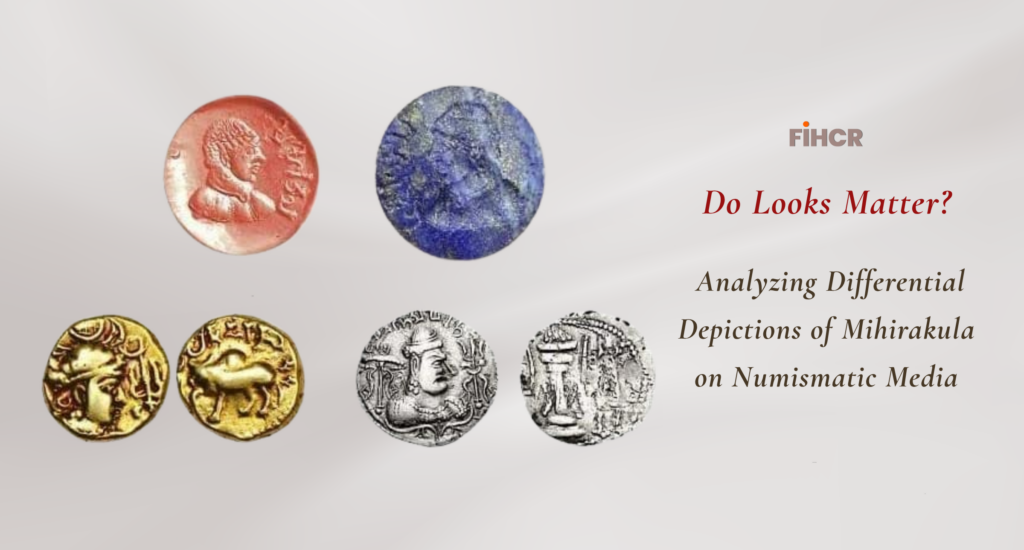
Looks, especially of regnal personalities, imperatively mattered in Early India. Coins and seals of the Hūṇa king Mihirakula (c. 515-530 CE) variably depict him, in ways not attributable to changes in age or appearance. This article would assess and analyze the subterranean contexts behind variegated ‘numismatic looks’ of Mihirakula, and glean the politics of image-making and stylistic subterfuge of the eponymous king, and assert how even quotidian articulations as ordinary as looks acted as idiomatic heralds of epochal etymologies.
Looks, not unlike contemporary times, mattered quite phenomenally in the ancient times as well. And like all other things, ability to get your appearance historicized, again like modern times, was asymmetrically skewed towards the elite, the noble and the regal. Thence, kings and emperors take the lion’s share in when the question comes to historical records about appearances, a consideration that may now seem petty and pedantic, but in antiquity, carried portentous promise. Such an assertion stands amplified by the fact that, unlike omnipresent digitised media, occasions to exhibit ‘royal-figure’ of the incumbent ruler were very few. Most of them thence rightly depended on coins to get their looks disbursed amongst the common man. But, what would you say when one king, during the same time-period, is shown with bewilderingly different looks? More importantly, what could have been the cause behind it- artistic disaster, or clever politicking?
Mihirakula (c. 515-530), the brutal Hūṇarāja of Buddhist texts, was the son and successor of the Hun who shook the Gupta Empire- Toramāṇa, and therefore the second leader of the Indian branch of Alchon Hūṇas, which, after trembling entire North India, withered away into historic obscurity. While Toramāṇa was known for his strategic operations, syncretic approach and intense desire to emulate the ‘Indic’ way of doing things, his scion was not, what one would say, a chip-off the old block. Buddhist texts written centuries after hold ravenous grudge against Mihirakula, and accuse him of ordering mass-persecutions and enjoying frightening, sanguine torture of Buddhist monks, until he met his match, that too twice, from the hands of Yaśovarman, the Aulikara king Mandasore (c. 515-534 CE) and Narasiṃhagupta Bālāditya (c. 500-530 CE), one of the last king of Imperial Gupta lineage. While the catastrophic Hunnic storm was calmed with humiliating defeats inflicted by Indian …………………………………………………………………………………………………………………………………… powers, under Mihirakula, remnants of the botched Hūṇa swarm found shelter in the serene valleys of Kashmir.
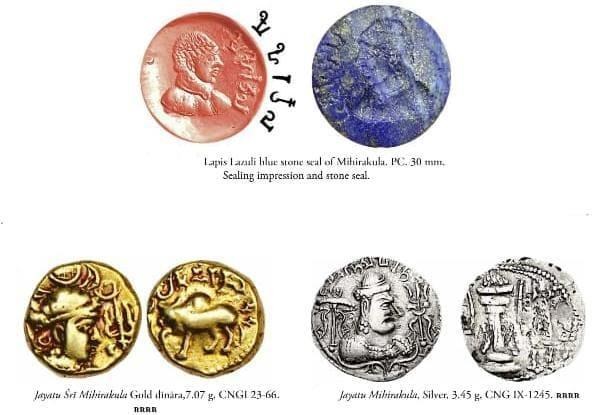
With historic vignettes in view, we can now turn attention towards the historic look of Mihirakula on his coins and seals (see fig. 01). While neither spectacular from aesthetic point of view, nor visually arresting like those of the Indo-Greeks, these samples nevertheless help us ‘see’ a person who predates us by more than half a millennium. But, caveat emptor, for numismatic appearances are, more often than not, stylized, and project not what the portrayed person looked like, but the way he intended himself to appear amongst his public. Still, even this half-truth holds much importance, as it secretly tells us of individualistic personal vagaries, royal preferences and ideas of portraiture of that era. But, what should one say when the same person appears starkly different on different issues?
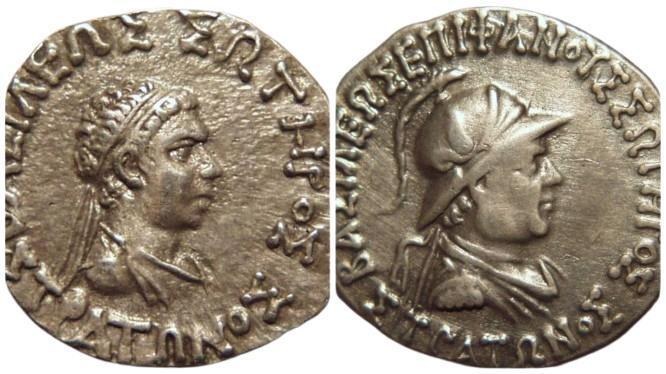
It is not that rulers’ appearances on coins cannot change; naturally, age takes its toll, and make Strato I (c. 125-110BCE) turn from a jubilant youth to a mellow, meek and emaciated; moreover, irresistibility to follow a ‘trend’ or ‘fad’ can even make those rulers mint their bust-figures who had previously issued coins with only symbols and designs (the Sātavāhanas). However, even metamorphosis has limits- it neither cannot magically turn a swan-necked, rugged, weathered, dolico-cephalic faced king into a plump, round-faced cherubine, nor alter a Mongoloid look with a petrifying glaze, and let it acquire an autochthonous makeover. Mints cannot be accused here, as one can buy the argument of distortions in coin-figures for bronze coins, which had extremely limited spread and use, but not for gold, as such coins had to invariably undergo tight scrutiny; sometimes, even the ruler participated in such process. There are folk legends in Kashmir, which narrate that Mihirakula was obsessively conscious about his looks, and wasted no time in executing anyone who even implicitly ridiculed his looks!
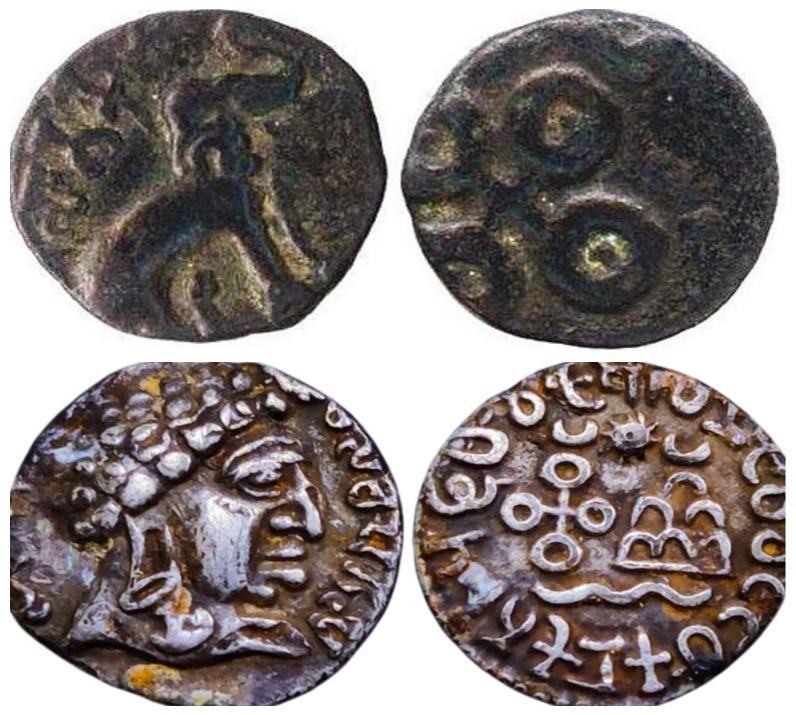
This fantastic farrago of facial features thus demands some explaining to do. If we may excuse maniacal bewilderment and capricious whimsicality, the answer must then be sought in the context of the situation. Two solutions immediately spring to mind- firstly, rulers, after conquering new lands, employed such tricks to prevent cultural and circulatory shocks; people accustomed to see stylized bust-figure of king as their primary device on gold-coins would have been certainly shocked to see that being replaced by an enigmatic person with an unnaturally elongated head; encephalic elongation was a common cultural practice amongst the Huns, but not in Sindh. The second form of shock could be considered as a market-based extension of the previous shock- a swift, sudden and surprising change in coin-devices and fabric would have made an already functional currency redundant. The second solution demands more attention- for rulers of foreign extraction, it was easy to conquer, but difficult to govern, that too legitimately. An obvious solution: image-making, through which culturally alien rulers gained both admission into the concerned socio-cultural milieu, and thereafter acquired atleast some semblance of legitimacy. It is a recurrent observation in annals of Indian History- Mahmūd Ghazni invoked Avatāra legends, while many gold-coins of Mohammad Ghorī featured Goddess Lakṣmī on the reverse. Even Toramāṇa practised this tactic when he styled himself as Prakāśāditya, undoubtedly following Gupta precedents. It is thus not unreasonable to suggest that Mihirakula, in this connection, was indeed a chip off the old block.
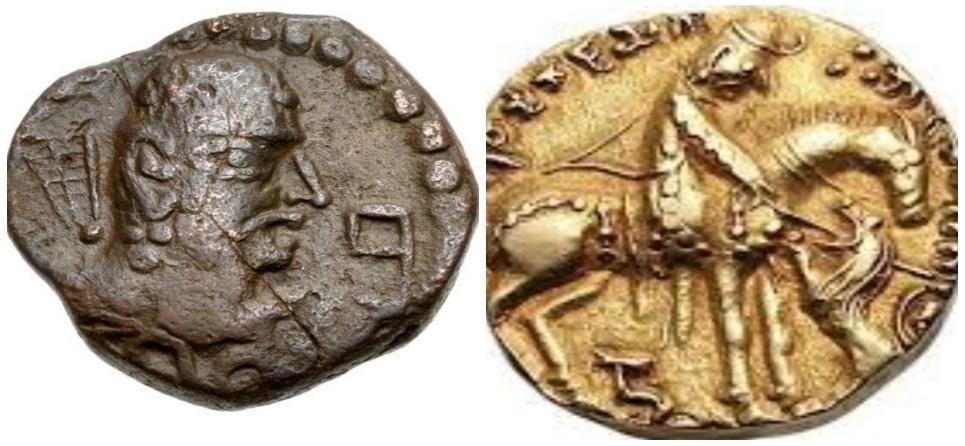
But, in this conundrum, would the original look of Mihirakula stand up? The most suitable candidate look is certainly the third one (silver coin, fig. 01), which not only exceeds the others in number, but also resembles the look of Toramāṇa on his coins. It is possible that such a look on coins circulated in Hūṇa-dominated polities and areas, where, it exhibited Mihirakula as the true, natural successor of Toramāṇa, and ensured legitimate lineage-succession. Whatever be the truth, it cannot be denied that what we may consider ubiquitous was sometimes, rather unexpectedly, a prime concern for historically significant individuals (read: kings). Also true is the fact that, in the table of concerns of the humble and the regal, the question of looks has always topped the charts.
For Further Reading
- Ali, Daud. (2001). Courtly Culture and Political Life in Early Medieval India. Oxford: Oxford University Press.
- Altekar, A.S. (1957). Coinage of the Gupta Empire. Varanasi: Banaras Hindu University Press.
- Bakker, Hans T. (2021). The Alkhan: A History of the Hunnic People in South Asia. Groningen: Barkhuis Publications.
- Balogh, Daniel (ed.). (2021). Hunnic Peoples in Central and South Asia: Sources for their Origin and History. Barkhuis, Groningen: The European Research Council.
- Erkipçak, H.T. (2024). “Toramāṇa and the Date of Gwalior Inscription of Mihirakula: A New Interpretation”. Central Asia Journal. Vol. 66 (1&2), pp. 97-110. Harrassowitz Verlag · Wiesbaden.
- Falk, H. (2023). “A Silver plate from Northern India relating to the accession of Prince Skandagupta”. Annual Report of the International Research Institute for Advanced Buddhology at Soka University. Tokyo: Volume XXVII.
- Finbarr, Barry Flood. (2009). Objects of Translation: Material Culture and Medieval “Hindu-Muslim” Encounters. Princeton, NJ: Princeton University Press.
- Kaul, S. (2018). The Making of Early Kashmir: Landscape and Identity in the Rājataraṅgiṇī. New Delhi: OUP Press, India.
- Kumar, Sanjeev. (2024). Treasures of the Gupta Empire: A Numismatic History of India’s Golden Age, 2md Edition. Oxford: Archaeo-press Publishing.
- Narain, A.K. (1957). The Indo-Greeks. Oxford: Oxford University Press.
- Shastri, A.M. (ed.). (1999). The Age of the Sātavāhanas. New Delhi: Aryan Books International Ltd.
- Tandon, P. (2015). “The Identity of Prakāśāditya”. Journal of the Royal Asiatic Society, 25(4), 647–668. http://www.jstor.org/stable/24755982.
- Vaissiére, E. (2012[2007]). “A Note on the Schøyen copper scroll: Bactrian or Indian?”. Bulletin of the Asia Institute, 21, p. 127-130.
- Willis, M. (2005). “Later Gupta History: Inscriptions, Coins and Historical Ideology.” Journal of the Royal Asiatic Society. 15:131-150.
© 2026 Foundation for Indian Historical and Cultural Research (FIHCR). All rights reserved. This article is the intellectual property of the Foundation for Indian Historical and Cultural Research (FIHCR). No part of this article may be reprinted, reproduced, or transmitted in any form or by any means, whether electronic, mechanical, photocopying, recording, or otherwise, without the prior written permission of FIHCR.