
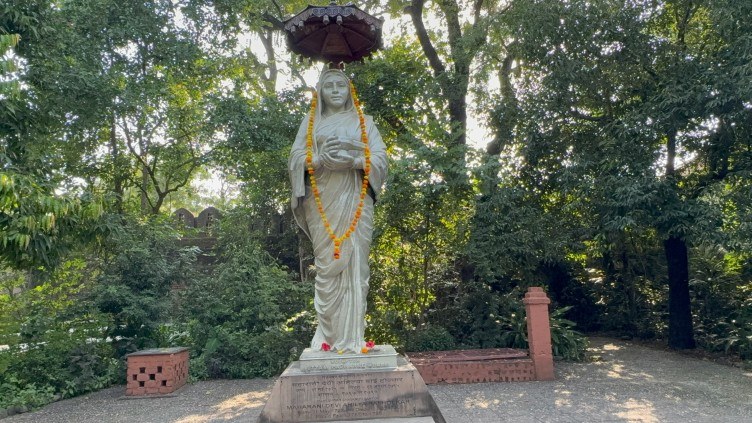
About a year ago, during a team meeting, our founder, Dr Vikram Sampath, mentioned that we would be pitching a proposal to the Madhya Pradesh government for a project on the life of Devi Ahilyabai Holkar. I remember quickly opening another tab to search her name. I had heard of her, of course, but I realised in that moment how little I actually knew about her as a historical figure. Even before I officially became a part of the project, I began reading up on her informally. Two things became clear almost immediately: first, she was a remarkable leader; and second, I was never taught a single thing about her in school.
The Classroom Problem
If you did not study under the Maharashtra State Board or do not belong to Indore, chances are your knowledge of her is just as thin as mine was. When I think about my school education, I remember exactly two female historical figures: Razia Sultan of the Delhi Sultanate and Rani Lakshmibai of Jhansi. They were presented as the epitome of female rebellion, defined by their struggle against an all-powerful male nobility and the British, respectively.
The narrative we are fed suggests that for a woman in history to be “strong,” she must either challenge male-dominated society or die a martyr. We were never taught about the administrative genius of strong women like Rajmata Jijabai Bhonsle, Rani Tarabai Bhonsle, or Rani Ahilyabai Holkar.
When I mentioned to a friend that I was working on a project about her life, she looked at me blankly and asked, “Who is she?” I was taken aback, but honestly, if I weren’t working in historical research, I would have asked the same thing. For most people who do not pursue history professionally, the subject effectively ends in the tenth grade. All that remains in the collective memory is the Revolt of 1857 and the freedom struggle. While learning about Rani Lakshmibai gave me a sense of pride, learning about Razia Sultan felt increasingly hollow. Eventually, I learned that it was she who demolished the Kashi Vishweshwar Mandir in the 13th century and built a mosque atop it. Now, I wonder why the curriculum then prioritised a woman who destroyed sacred heritage over the woman who spent her life rebuilding it.
Cultural Renaissance
The Somnath temple has a history of multiple desecrations, which is why this year we celebrate the Somnath Swabhiman Parva, marking 1,000 years since the raid of Mahmud Ghazni in 1026. A millennium later, all those dynasties have turned to dust, but Somnath stands tall. The grand temple we see today was built in 1951.
Just to the right of the main temple stands a smaller Shiva temple called the ‘Maharani Ahilyabai Dwara Punarsthapit Shree Somnath Mahadev Mandir.’ After the main temple was desecrated by Aurangzeb in 1706, it was Rani Ahilyabai who, in 1783, built that smaller temple to ensure the deity had a home and the devotees had hope. For nearly two centuries, that small shrine assured people that Somnath had never left.
This was not an isolated project. Silently and resiliently, she reconstructed more than 100 shrines across Bharat, from Kedarnath to Rameshwaram. She ruled only as a devotee and the humble servant of Shiva. Additionally, she established annual grants to impoverished temples and constructed ghats and dharmashalas for pilgrims. What is even more remarkable is that she did this by understanding and abiding by the political situation of her time.
India was a fractal of shifting loyalties in the 18th century; the Peshwas, the Rajputs, the English, and Tipu Sultan were all hungry to expand. Carrying out nationwide activities that went beyond the limits of the Peshwa empire required grit, calculation, and a strong sense of the civilizational unity of the land.
A Stalwart of Feminism
When Western feminism is applied to India, it establishes a rigid binary where a woman is cast as either a victim or a martyr. But women like Rani Ahilyabai and Rajmata Jijabai defy this binary. Rani Ahilyabai neither became a victim nor a martyr. Her husband was killed in an accident in 1754 when she was merely twenty-nine years old. She had prepared to commit Sati, but her father-in-law, Malharrao Holkar, who loved her like a daughter, persuaded her against it. Instead, she chose the difficult path of learning administration and ruling in his absence.
When Malharrao passed away in 1766, she ruled on behalf of her son as his regent. Even after her son died, she fought off attempts by the Peshwa’s uncle to usurp her kingdom and refused to adopt a male heir just to satisfy tradition. Instead, she requested the Peshwa to recognise her as the rightful heir to the Holkars, with Tukoji Holkar serving as the military commander. Once she finally secured the throne, she sacrificed all power and wealth, declaring that she would rule on behalf of Shiva, to whom everything belongs.
She funded her religious and public works, like the Kashi Vishweshwar temple, the Manikarnika Ghat, and the Vishnu Mandir in Gaya, out of her personal Khasgi funds rather than state taxes. In the book Maheshwar Darbarchi Batmipatre, we find letters detailing the minute progress of these projects, down to the installation of lights on a new ghat. She brought about a renaissance without an open revolt, playing by the rules of her time to preserve her kingdom.
Beyond the Classroom
Gen Z and Gen Alpha are often dismissed as distracted, yet they are growing up in a vacuum. If our girls today know more about Sappho than they do about Rani Ahilyabai, that is our failure, not theirs. While it is heartening to note that the new NCERT Grade 8 Social Studies textbook introduces the legacies of both Rani Ahilyabai Holkar and Tarabai Bhonsle, it does not change the fact that many generations missed out on learning about them.
The responsibility does not solely rest with the government. When we think of history merely as a school subject, we end up losing our sense of identity. The responsibility lies with us to talk to our children about the history they should be learning, irrespective of what is being taught in the classrooms. We want them to go abroad and appreciate the classics of the West, but we also want them to stand tall and tell the world the story of our own leaders.
Why Ahilyabai Matters Today
We are often taught that British rule was the force that united India, which was otherwise merely a collection of fragmented princely states. However, the legacy of Rani Ahilyabai Holkar challenges this narrative. She commissioned temples across the entire length and breadth of Bharat. Why did she view these lands, which were not under the rule of the Holkars or even the Marathas, as her own?
She had a vision of a unified Bharat, passed down by the great leaders who came before her. She understood that the entire country shared a single cultural soul. She viewed the defence of Kashi or Somnath as a pan-India duty. Her work in rebuilding Hindu shrines and establishing dharmashalas for pilgrims should be seen as a form of resistance. Through it, she marked the cultural and spiritual borders of this vast land long before the British did.