
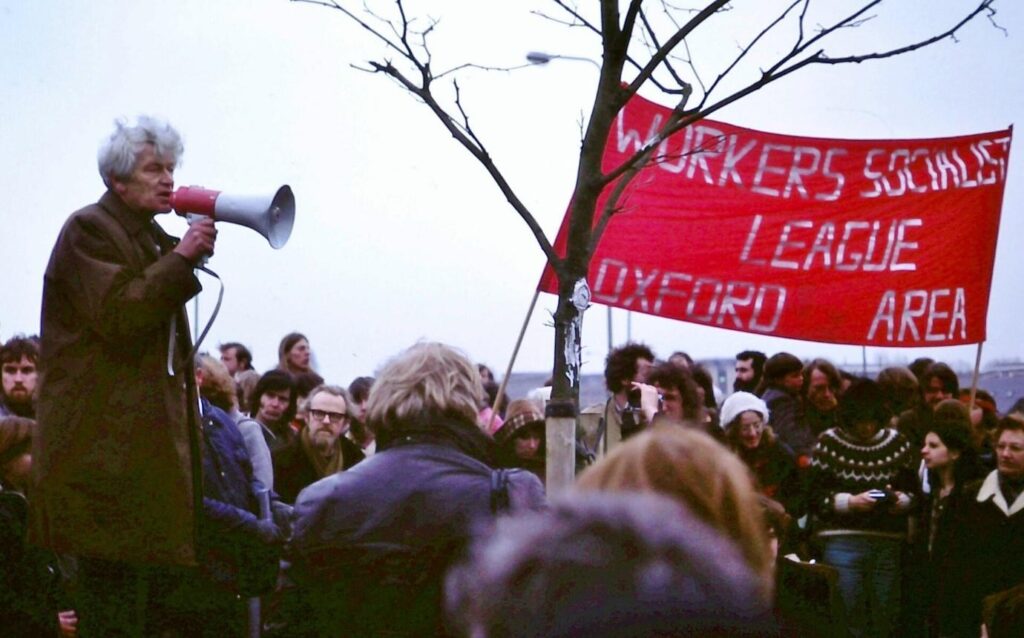
Edward Palmer Thompson (1924-1993) was an English historian. The trajectory of his life was remarkable and adventurous. He fought in WWII as a callow youth, in fact, as a tank commander, no less. Even though his parents were practicing Christians and missionaries, he embraced godless Marxism and made it his guiding philosophy as a historian. He was, however, an unusual sort of Marxist. He bravely challenged the then shibboleths of Left historiography and, while remaining within its perimeters, formulated an altogether new approach towards the past.
Thompson caught up with his education after WWII at the University of Cambridge. He afterwards taught history at the University of Leeds. Thompson later quit the institution to join the University of Warwick.
Thompson is best described as an activist historian. While teaching history, he avidly took to peace activism. Presumably, his antipathy for war stemmed from the fact of having witnessed its horrors close at hand. Thompson did not let his commitment to world peace to be clouded by his advocacy of Marxism and association with the political Left – he was a member of the Communist Party of Great Britain (CPGB). He, thus, unequivocally condemned the Soviet invasion of Hungary in 1956. He also quit the CPGB over this issue as its pro-Soviet leadership was unwilling to do the same.
Disillusioned with Soviet communism, Thompson founded the journal New Left Review with a number of other like-minded academics. He and his comrades remained faithful to Marxism as an ideological mode, but they no more wished to adhere to an inflexibly party-centric, Soviet oriented interpretation thereof. This was the beginning of a fresh turn in Left historiography which, to a considerable extent, was led and exemplified by Thompson.
Thompson rejected the Soviet historians’ rigid economic determinism and introduced, what we may term, a humanist point of view in the Marxist interpretation of the past. Apparently, in his perspective, an unjust, oppressive regime was not conducive to the pursuit of historical truth and could not produce an authentic picture of history. Thompson, thus, displayed the remarkable moral courage to give up a hegemonic, or de rigueur, interpretive approach among Left historians.
The most remarkable and compelling instance of Thompson’s ‘Marxist humanism’ is his book Making of the English Working Class. The scale of this work is in one word ‘monumental’; it runs into more than eight hundred pages in the edition in which I have it. In so many words, this very large and detailed monograph rejects the economically deterministic Marxist notion that class consciousness is a natural outcome of the industrial labour relations. Instead, Thompson demonstrates in the Making of the English Working Class that industrial workers do not acquire their class consciousness passively and spontaneously simply by dint of providing their labour in an industrial setup. They do so actively by exercising their agency in a variety of ways so that they also simultaneously generate an entire culture unique to them. To give a few examples, the Making of the English Working Class depicts the English industrial workers acquiring their class consciousness by forming self-help groups, playing street games, and even veering towards certain non-conformist interpretations of Christianity. Thus, as Thompson lyrically argues, they are ‘present at their own making’. This was a conclusive rejection of what is theoretically termed ‘structural Marxism’ in which human beings are simply looked upon as cogs in the overall social machinery of production relations without any agency of their own. Thompson considered this approach ‘Stalinist’ and he would later scathingly critique it in another of his books The Poverty of Theory. It is well known for tearing into the French Marxist philosopher Louis Althusser (1918-1990), one of the most noteworthy votaries of structural Marxism.
Now, let there be no illusions, my rejection of Marxism is complete and unambiguous. Nonetheless, I admire Thompson for his moral courage and profound humanist compassion. I also admire him because he understood the historian as an individual who actively stands up for their sense of right instead of just delivering sophisticated waffle from atop a remote ivory tower. A further reason I admire him is because, even though he might not have realised this, his scholarly corpus actually provides one with a set powerful conceptual tools to challenge Marxism. Finally, I admire him for his capacity to write a lyrical, lilting prose which never takes recourse to jargon.
Image credit: https://commons.wikimedia.org/wiki/File:E_P_Thompson_at_1980_protest_rally.JPG
